






For families living in communities frequently threatened by typhoons, floods, droughts and other climate-related hazards, an early warning can mean more than information—it can mean having enough time to protect loved ones, secure livelihoods and move to safety.
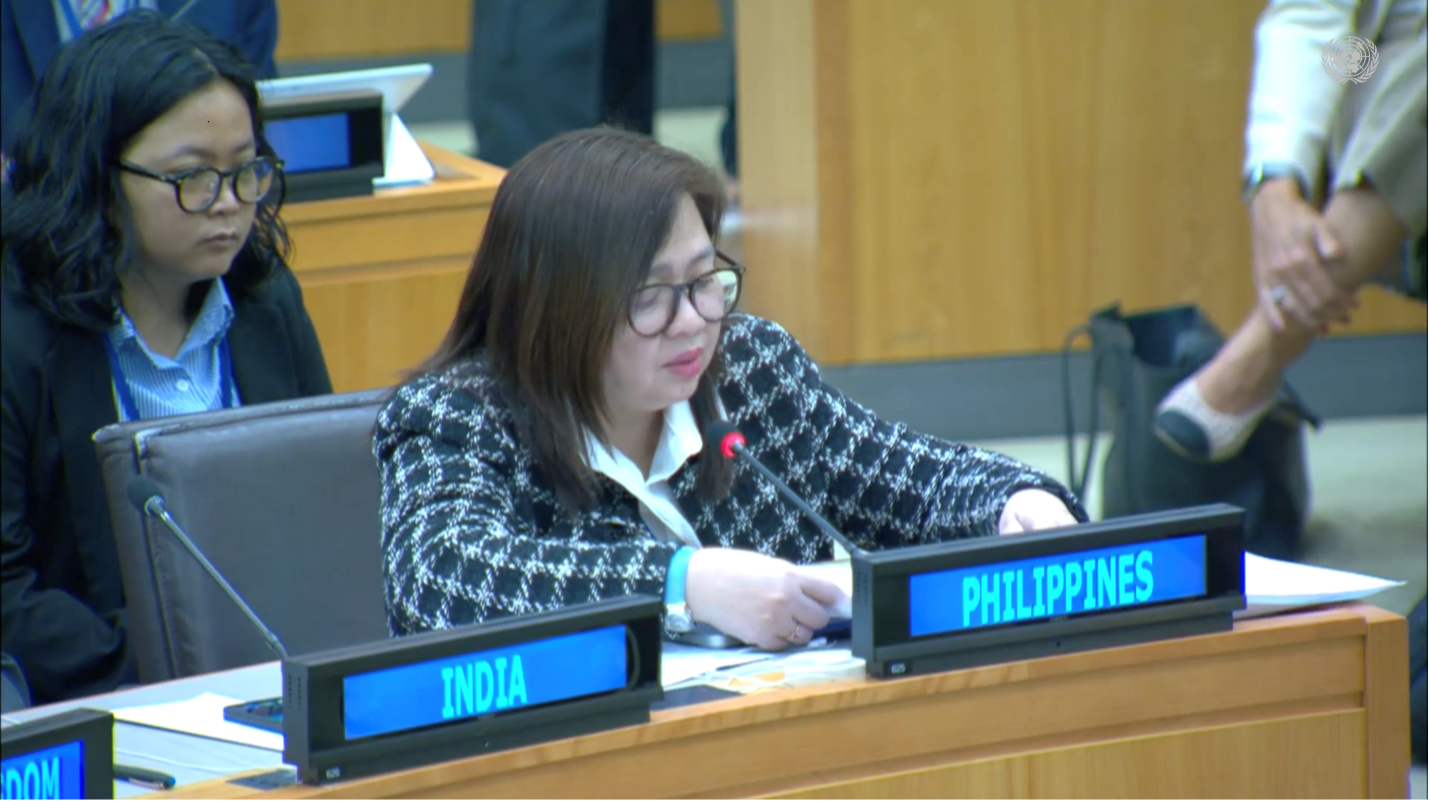
That human reality was at the center of the Philippines’ call for stronger and more sustained climate adaptation financing during the Solutions Dialogue on Financing Adaptation in the Era of Global Overshoot at the United Nations Headquarters in New York.
Atty. Analiza Rebuelta-Teh, Department of Environment and Natural Resources (DENR) Undersecretary for Finance, Information Systems, Climate Change and Administration, urged the international community to move beyond short-term, project-based approaches and support permanent, nationally owned systems of resilience, particularly early warning systems that can turn climate information into timely action.
For the Philippines, a climate-vulnerable island nation, increasingly intense and compounding hazards are already affecting lives, livelihoods, food and water security, ecosystems and economic stability.
“Adaptation cannot remain reactive,” Rebuelta-Teh said, emphasizing the need for new, additional, predictable and scaled-up public finance so developing countries can respond to growing climate risks at the speed and scale required.
Making warnings matter where people live
An early warning system is only effective when information reaches people in time and communities have the resources and capacity to respond.
Rebuelta-Teh highlighted the need to make financing for early warning systems predictable and permanent, treating them as essential public infrastructure rather than temporary projects. This includes providing multi-year financing for the systems and institutions that communities depend on before, during and after climate-related emergencies.
She also called attention to the “last mile” between receiving a warning and taking protective action. This means investing in local risk information, reliable warning dissemination, community preparedness, and financing mechanisms that can be activated quickly when danger is detected.
Equally important, she pointed to the often-overlooked “unfunded middle”—the continuing costs of operating and maintaining systems, collecting data, retaining technical personnel, upgrading technology and providing training.
For communities, these behind-the-scenes investments can determine whether a warning remains simply a message or becomes an opportunity to act.
A long-term investment in people and communities
The financing challenge is significant. Global adaptation costs for developing countries are projected to reach $310 billion to $365 billion annually by 2035, while debt pressures and high capital costs can further limit access to resources.
In the Philippines, the economic cost of inaction across eight priority sectors identified in the National Adaptation Plan is estimated at ₱645 billion annually.
These figures underscore why climate adaptation is not only an environmental concern but also a matter of protecting families, livelihoods, public services and development gains.
The Philippines has also strengthened its engagement in global disaster-resilience efforts through its membership in the Coalition for Disaster Resilient Infrastructure (CDRI), which brings countries together to advance resilient infrastructure and disaster-risk reduction.
For Rebuelta-Teh, the goal is ultimately to build systems that can endure beyond individual projects or funding cycles.
“For the Philippines, our goal is to move from isolated projects to permanent, nationally owned systems of resilience,” she said.
With predictable international support aligned with national planning and budgeting, the country is seeking to ensure that climate warnings do more than alert people to danger.
They should give communities the time, resources and confidence to act—and help protect the lives and livelihoods that depend on it.