
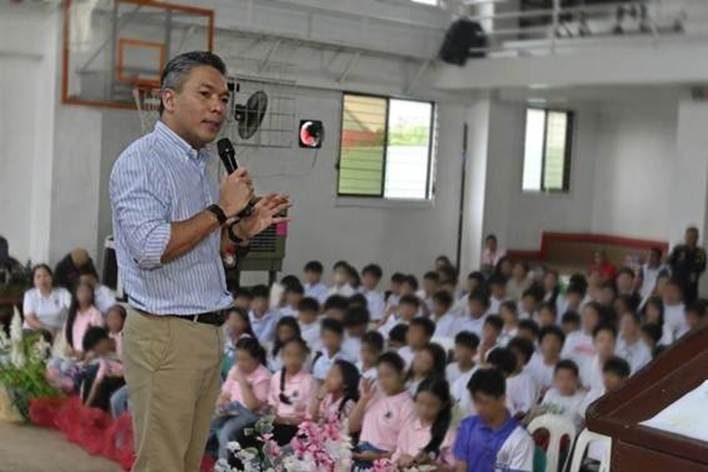






Schools have a vital role in creating learning environments where students feel safe, respected, heard, and supported. This was emphasized during a recent anti-bullying awareness workshop at Bagong Tanyag Integrated School (BTIS) in Taguig City, which brought together learners, parents, and teachers to discuss ways to prevent bullying and strengthen support for students.
Department of Justice (DOJ) Undersecretary Atty. Ian Norman E. Dato served as the resource speaker, leading discussions on how students can recognize bullying, understand their rights, and know where to seek help when they experience or witness bullying.
Dato emphasized that preventing bullying is a shared responsibility within the school community.
“Addressing bullying is not only the responsibility of the person being bullied. It is also the responsibility of teachers, parents, school personnel, and everyone in the school community to listen, respond, and make sure that every student feels safe and protected,” Dato said.
Awareness Must Lead to Action
The workshop highlighted the importance of combining awareness with appropriate action. Students who experience or witness bullying should feel encouraged to speak up and report their concerns, while adults in the school community need to be prepared to listen, respond, and provide appropriate support.
Dato explained that while government agencies can assist when cases require intervention beyond the school, bullying incidents involving learners should primarily be addressed by the school under the Anti-Bullying Act, particularly when incidents occur within the two-kilometer perimeter of the school.
At the school level, Child Protection Committees play an important role in receiving concerns, responding to reported incidents, and helping ensure the safety and welfare of learners. These mechanisms allow schools to respond to concerns early and provide appropriate assistance before situations become more serious.
Strengthening Support for Learners
The DOJ’s role becomes particularly relevant when cases require assistance beyond the school. Dato cited Department Circular No. 026, Series of 2026, issued on July 30, 2026, which establishes an Accessibility and Referral Mechanism on Complaints of Bullying.
Under the mechanism, DOJ Action Centers and National Prosecution Service offices nationwide can accept and process bullying-related complaints or referrals, providing a formal pathway for cases that may require legal or prosecutorial intervention.
For BTIS Principal Donnabel F. Balantac, building a safe learning environment begins within the school community.
She noted that the workshop was especially relevant for students transitioning from elementary to junior high school, a period when learners adjust to new surroundings, relationships, and social dynamics.
“Our school should be a place where everyone feels safe, respected, and valued,” Balantac said.
She also encouraged students to recognize their own role in creating a positive school culture. As they move through junior high school, students can serve as role models for younger learners and help promote an environment where bullying is not accepted.
Students and Parents Have a Role
Guidance Advocate Jonathan L. Carlos stressed that creating a safe school environment requires active participation from both students and parents. Awareness becomes meaningful, he said, when learners feel comfortable reporting concerns and seeking assistance.
Master Teacher I Josephine Jane A. Daileg likewise encouraged participants to apply the lessons from the workshop in their classrooms and communities. She emphasized that every member of the school community can contribute to making others feel protected, valued, and respected.
The DOJ workshop at BTIS underscored that bullying prevention goes beyond responding to individual incidents. It involves creating a school culture where students understand their rights, know where to seek help, and feel confident that their concerns will be heard.
By strengthening awareness, encouraging students to speak up, maintaining responsive child-protection mechanisms, and promoting respect and inclusion, schools can help address bullying early and provide learners with a safer environment in which to learn, participate, and grow.